Showing posts with label Jaggery. Show all posts

Saturday, January 14, 2012

Happy Sankrant Everyone ! Tilgul Ghya Goad Bola!!

Gulachi Poli

It's that time of the year again folks, winter is in full bloom in Pune and it is deliciously cold. After experiencing the severe winters in UK for last  six years this mildly cold weather of Pune is a delightful change for all of us. I admit it still makes getting up early in the morning on school days very difficult, and almost everyday I am tempted to let my little one sleep and not bother him to go to school. Hmmm .... but that's not the way it works does it? If I give in to this temptation he would probably miss school every second day, and that is definitely a big NO NO.
Its also Sankranti time. One of my favourite festivals! I love tilgul and gulachi poli and halwa and the fact that the colour black is celebrated. I have a favourite black saree which I always make a point to wear on Sankranti. Sankrant is normally celebrated on the 14th of January,only this time it is on the 15th. So tomorrow I'll be preparing gulachi poli, and tilgul.

 As with most Indian festivals which are in one way or the other associated with the seasons of the year , Sakranti too has an association with the winter season. Sesame and jaggery the 2 main ingredients here both produce heat in the body and are the main heroes in all the sweets prepared for this event.
Many married women also invite other ladies to their homes for a haldi-kumkum ritual ,during which tilgul is distributed and each lady also gets a small gift to take home. That's the fun part of this programme. It's great fun going into the markets which are jam packed with different goodies you can buy for your haldikumkum function.
Today I am going to share with you the recipe for Gulachi Poli, which is a delicious sweet poli made with a filling of jaggery and sesame. Its to be eaten strictly with generous dollops of homemade ghee. That's a must.
So here goes:

Ingredients for 10 to 12 polis

1/4 kg plain jaggery (available at any grocery store)
1/2 cup of roasted sesame powder,
1/2 cup gram flour
1/4 cup oil to roast the gram flour
1/4 tspn cardammom powder

For the outer poli cover:
2 cups of wheat flour
1 cup plain flour
1/2 cup fine semolina
1/4 cup gram flour
1/2 tblspn rice flour
1 pinch of salt
1/4 cup of very hot oil
1/2 cup rice flour to dust the poli when rolling it out

To make the filling:
Heat the oil and roast the gram flour until it changes colour slightly
Grate the jaggery. When the gram flour cools down add to it the  jaggery and the cardammom powder and the sesame powder. Knead the mixture until it all blends well together. You could even pound it a bit. Keep it to one side.

For the cover:
Mix all the ingredients for the cover and knead into a slightly stiff dough.
divide the dough into 18 to 20 equal portions and the jaggery filling into 9 to 10 equal parts
Now for every poli you need two portions of dough and one portion of jaggery.
Roll out all three portions into small discs of equal size. Place the jaggery portion in between the two dough portions and then roll out all three together into a thin poli the size of the regular phulka or roti.
Roast it on the tawa .
These polis will not be soft like normal rotis . They are slightly stiff to touch and break easily into smaller pieces. That's the way they should be.
They keep easily for 8 days without refrigeration.
Serve with big dollops of ghee.

Other Sankrant special recipes on Food-n-More:
 Sesame Snaps (Tilgul)Sesame snaps

Tilgul ghya goad bolaTilgul


Sunday, June 07, 2009

Wheat and coconut cream pudding

Bulgar Wheat and Coconut Cream Pudding

A couple of days back my good friend Kavita left UK and went back to India for good. Before leaving she gave me a bagful of groceries that she had left over and obviously couldn't finish before she left. This is a normal practice amongst us friends . Whenever one of us is leaving for good we kind of have a grocery distribution programme between us . The person who is leaving accumulates all the store cupboard groceries that she cannot use up and asks us to take what ever we fancy . So everyone kind of gets to explore her groceries which is fun . Although of course it is no fun to have one of your group leave forever. It leaves a kind of empty void that is very difficult to get used to.

So this time along with other things I got something that I had never used before. She had a container full of hand-threshed whole wheat from her family farm back home in India. So it was of the best quality ever. K said her mom-in-law and sisters in law make a kheer out of it although she had never tried it herself it UK. My initial enthusiasm on recieving it faded a bit when I saw the whole grain and wondered how I would cook it. I have cooked bulgar wheat before but this was something else altogether.

Hand Threshed Whole Wheat

So I tentatively cooked it in my pressure cooker with some water. Thankfully it cooked beautifully and the kheer or pudding that I made from it turned out just fabulous. I cooked it in coconut milk and the taste was mind-blowing. So thanks to K for that! Bulgar wheat being widely available and imparting the same taste is my recommendation as a substitute to the wheat I used for this pudding

Ingredients:

3/4 cup Bulgar Wheat,

1 can of coconut cream

1/2 cup fresh grated coconut,

3/4 cup jaggery (or use light brown muscovado sugar)

a generous pinch of saffron,

1/2 a tspn of cardammom powder

1/2 cup approx milk (to thin the kheer if needed)

2 tblspns ghee (clarified butter)

Method:

Cook the Bulgar wheat with the grated coconut and some water in a pressure cooker for 3 whistles.

In another pan heat the ghee and add the cooked wheat and stir for a couple of minutes

To this add the coconut milk/cream from the can and stir it in well,

Next add the jaggery/sugar and the saffron . (you can soak the saffron in warm water or milk for some time but it's not neccessary)

Now simmer the kheer /pudding for a good 20 to 25 minutes on a very low heat, stirring occasionally so it does'nt stick to the bottom of the pan.

If you would like it a bit thinner in consistency add the milk. Remember it becomes thicker and thicker as it cools down, so it a good idea to have it a bit thinner than you would like when it is hot.

Switch off the heat after 25 mins and sprinkle the cardammom powder and stir it in well.

This pudding tastes good warm or chilled. We love it chilled. So I chilled it in the fridge for an hour before serving. To serve decorate with cashews or almonds or any dry -fruit of your choice.

Monday, March 09, 2009

Happy Holi everyone !

Puran Poli


The Spring Festival of India, Holi which is on the 10th of March this year is a festival of colours. Celebrated in March or April according to the Hindu calendar, it was meant to welcome the spring and win the blessings of Gods for good harvests and fertility of the land. As with all the Hindu festivals, there are many interesting legends attached to Holi. It is the second most important festival of India after Diwali.

Special sweets are prepared on Holi with the Puran Poli taking the place of pride and in the evening friends come together around a bonfire which is a representation of burning away all that is evil and starting afresh. It is a festival of fun and frolic and the exuberance and the festivity of the season are remarkable. The day after Holi is called Dhulwad in Maharashtra and is celebrated by splashing colours and water on each other. This is particularly popular with teenagers and collegians who are seen going around the city in large groups on their bikes and scooters having a fantastic time.

So coming back to Puran Poli this is what I have for all of you today. Puran Poli is the like the heart and soul of Maharashtrian cuisine and and it's a true test of your cooking skills. It's a skill not just learnt from a cookbook but something that is handed down generations. The best Puran Poli I have eaten is the one made by my mother-in-law. They are just the ultimate and I really have to keep a check on how many I eat . Having said that I also take great pride in saying that my own Puran Polis come out beautifully as well considering the fact that I make them only once or twice a year. My family loves them and we can never have enough. So I have to share them with all of you, don't I?

For those to whom Puran Poli is a new dish, Puran is basically a sweet stuffing made from chana dal and jaggery. Poli is a flat bread. This puran is stuffed in dough and then rolled out gently to make Puran Poli which is eaten with loads of melted ghee. It is heaven on earth.

Here's how I go about it:

Ingredients for the Puran:

1.5 cups chana dal

1 cup jaggery

1/2 cup sugar,

1/4 tspn grated nutmeg

1/4 tspn cardammom powder,

1/8 tspn saffron strands soaked in warm water

1/4 tspn salt,

3 cups water to cook the chana dal

Ingredients for the outer cover or Poli

1 cup wheat flour finely sifted

1 cup plain flour (maida)

1/4 tspn salt

8 to 10 tblspns of oil to knead the dough,

1 cup rice or plain flour to dust while rolling out the poli

Method for cooking the Puran:

Ideally the chana dal is cooked in a open saucepan till it gets soft and mushy but I prefer to cook it in a pressure cooker as that is much faster and and I don't have to watch it all the time. So place the chana dal with double quantity of water and pinch of turmeric in a pressure cooker container and then pressure cook it . I cook it for a little longer that I would cook normal dal .

While this is cooking prepare the dough for the poli. Mix the 2 flours and salt and form a soft dough by adding enough water. Pour all oil and knead well. The quantity of oil seems a lot but believe me it is necessary to make a delicious puran poli. Leave the dough covered for 1 to 11/2 hour.

When the dal is thoroughly cooked and mushy remove the container from the cooker and drain the excess cooking liquid from the dal. This is called Kat and is used to make a delicious spicy soupy meal accompaniment called Katachi Amti.

What I do now is blend the dal well with a hand mixer still it is smooth with absolutely no grainy texture. Then place this dal ,the jaggery and sugar in a heavy bottom pan and cook it on a low flame stirring frequently till the mixture thickens to the point where if you insert a serving spoon in it , it will stand in the mixture. This is how experts test it. Finally add the nutmeg , cardamom powders and the soaked saffron and give it all a good mix . Switch off the gas. Stirring the mixture frequently is important as it sticks easily to the bottom of the pan.

After the Puran has cooled you can rolling out the Puran polis by taking a ball of dough and thrice as much puran . Roll out the dough a little then place the Puran over it and pulling all the edges to the centre close the mouth of the dough. Dust a small amount of flour on the surface and on the rolling pin and gently roll the poli ensuring that the puran is evenly spread inside without breaking out of the dough.

To roast you need the tawa (skillet) just moderately hot. Roast on one side then flip once and the poli is done. Do not over cook. This is a delicate creation and treat it accordingly. To serve melt ghee and spoon generously( and I mean really generously) over the poli and with some warm saffron flavoured milk alongside. Serve hot.

Wednesday, September 03, 2008

Ganapati Bappa Moraya

Talniche Modak

A very big Hello !!! to all my dear readers and blog friends. I am back after a very very long break and believe me I am now really really ready to blog again. My trip to India was super. It was one big social event. I was visiting friends and family left ,right and centre. Visited some nice restaurants too and ate lots of delicious stuff and inspite of all the hogging I did there I lost some weight. Isn't that amazing? I am very happy.

And here I am with my latest dish that I have just prepared minutes ago and is fresh off the stove. I couldn't have chosen a better day than today to start blogging again . Yesss! It's Ganesh Chaurthi today . That special festival of Maharashtra which is celebrated for 10 days with great pomp all over the state. Before starting any new venture we believe in praying to Lord Ganesh or Ganapati Bappa as he lovingly called in Marathi. It is believed that Ganapati can remove any obstacles that may be a hindrance in your way to success and that is the reason why any new venture is first started by praying to Lord Ganapati.

So I am definitely starting on a very good day. What I have for you today is also a very special dish made particularly on Ganesh Chaturthi as it is Ganapati Bappa's favourite. It is Modak. The one I have for you today is the fried version

Fried Modak

Ingredients:
For the outer cover
1 cup Plain Flour,
2 tspn Fine Semolina,
3 tblspn very hot oil
A pinch of salt
Ingredients for the filling:
210 gms fresh shredded coconut
1 cup jaggery (palm sugar)
1/2 cup sugar
1/2 tspn cardammom powder
1/2 tspn nutmeg powder

Procedure:
Filling: (Filling can be prepared one day in advance and kept ready)
1. In a heavy bottom pan mix the coconut, jaggery and sugar on a moderate to low heat . Keep stirring until the the mixture loses moisture and becomes slightly dry. This takes about 10 t0 15 minutes
2. Switch off the gas and then sprinkle the two spice powders and mix well. The mixture is ready. Optionally you can make it richer by adding raisins, broken cashewnuts etc. Keep the mixture covered until you need it.

For the outer cover:
1. Mix all the ingredients and knead into a firm dough. Keep covered for at 30 minutes.
2. Before using soften the dough by drizzling a bit of Ghee (clarified butter) on it and pound it in a pestle and mortar. This is very tedious but very neccessary. It makes the dough pliable.
3. Now make small balls of dough. Roll out one ball at a time into a thin puri.
4. Place it on your palm and put a tspn full of filling in the centre. Pinch the sides of the puri at regular intervals and close the modak firmly from the top. Place the modak on a plate and cover the dish with a clean wet cloth so that the modaks do not dry out
5. Make all the modaks in the same way.
6. Deep fry 3 to 4 modaks at a time on a moderate to low heat. Let cool and then store a container.
This will make appoximately 21 modaks. The other version of Modak is the steamed version which is even more delicious. For the recipe click on the picture on the right side bar.

  • Have also updated Chintu cartoon strip after a very long time. Sorry for not having updated for so long. Do scroll down and take a look.

Thursday, August 30, 2007

Ukdiche Modak (JFI Rice)


Ukdiche Modak

15th September is Ganesh Chaturthi and I am already in a tizzy. We are celebrating the Ganpati Festival this year at our home in the UK for the first time and boy are we excited about it. I have always celebrated this festival with the rest of my family so there was always either my mother or then later my mom-in-law who were in charge .This is the first time that I am going to be completely responsible for the way things turn out. So I am excited as well as nervous.

I already have visions of how I am going to decorate the room in which the Ganesh idol will be placed and what kind of sweets I can make for the daily Puja and Aarti. Speaking of sweets brings to mind the Show Stopper of the Festival Lunch,which are these Ukdiche Modak.

Ganesh Chaturthi and Ukdiche Modak have to go hand in hand. I cannot celebrate this day without these delicious creations. So best way to ensure that you can make these, is to take a trial run a few days before the actual day of the festival. And that's exactly what I did today. This was also my idea of a perfect entry for
Sharmi's event JFI Rice .
Of course like every year I called Aai for the recipe and for the important tips to remember while making them. Although the recipe is very simple the actual procedure requires a bit of practice.

Here's how I went about it:

Ingredients (For 7 to 8 Modak):

For the outer cover:
1 katori (see pic) very fine Rice flour (sieve the rice flour to get a fine and soft flour),
1 katori water,
a pinch of salt,

Ingredients for the sweet stuffing:
2 cups fresh grated coconut,
1 cup jaggery (palm sugar)
1/2 tspn cardamom powder,
1/2 tspn grated nutmeg

Steel Katori used in all maharastrian homes


Procedure for Outer Cover:

1.In a steel container mix the rice flour ,water and salt to make a smooth paste(see pic)


2. Pressure cook this paste like you would do for dal in a pressure cooker, (thats about 3 whistles and simmer for 5 to 7 mins)


3. Let the pressure cooker cool for a while before opening it.


Uncooked Rice Flour Paste


Procedure for the stuffing:


1. While the pressure cooker cools down prepare the stuffing.


2. In a heavy bottom pan mix the grated coconut and jaggery and cook the mixture for 20 to 25 mins on a very low heat, stirring frequently


3. After switching off the heat add the cardamom and nutmeg. Let the stuffing cool


Coconut and Jaggery Stuffing


4. After the rice flour dough which is called Ukad has cooled down enough to handle ,oil your palms well and knead this dough till it becomes very pliable and soft enough to fill and shape into a modak. Along with oil also use water on your hands to further assist you with this.


5. Now make a lemon size ball of dough ,place it between two oiled plastic sheets and spread out the dough with your thumb to the size of a puri (see pic)


6. Place this puri on your wet palm and place a tblspn full of stuffing in the centre. Make vertical pleats in the dough by pinching it at regular intervals between your thumb and forefinger (I wish I could show you a pic but I was struggling so much at this stage that holding a camera was simply impossible)


7. Now close the modak from the top by creating tapering shape .(Gosh! I am so bad at explaining this) But I guess all marathi readers will know what I am taliking about and for others the final product should look like the modak in the main pic and the pic below. )


8. To steam these I used an idli cooker and idli moulds. Use any kind of good steamer. At home in India we normally place a soft muslin in a colander ,put all the modaks in it and then place the colander just inside the rim of the pressure cooker and steam for 15 to 17 mins. Alternatively they can be steamed in an electric rice cooker too. Imp Note: Before steaming, dip each modak quickly in water and then place in the steamer. This prevents the modaks from cracking


Modak


Serve with generous dollops of homemade ghee. No ! don't say no to Ghee. You must have Ghee (or Sajuk toop as we call it) with Modak.

I hope my post inspires many of you to try them out this year, that's the reason why I wanted to post these a little before the 15th and secondly let me now go over to Sharmi's for JFI: RICE

Thursday, March 08, 2007

Sweet and Sour Mango Pickle


Though the weather is nowhere near warm in England, I know that summer has crept upon all my asian bloggo-buddies full blast. And what makes summer bearable? Its the mangoes of course. Mangoes, the one thing that I miss most here. I do eat mangoes in the UK ,not that I don't but somehow its not the same as eating mangoes in India. Calling the Alphonso Mango a fruit would be the understatement of a lifetime. Its not eaten its practically worshipped at breakfast ,lunch ,teatime and supper and then again as dessert after the meals.
I think the Indian summer adds to the charm. I still associate the hot summer days with school vacations and hot afternoons spent lazying in front of the telly with plates full of luscious mango slices which have been cut for you by your mom.
Equally irresistible is the raw green mango. I remember eating pieces of raw mango coated heavily with chilli powder salt and pickle masala while my mom and grandmother prepared this yearly pickle. And by eating I mean eating them till my throat was sore. Well this pickle is something that I still always get from my mom and now also from my mom-in-law. I think some things are best left for the veterans to make.But what I have for you today is a delicious sweet and sour pickle which is ready in a matter of minutes.
May I also add that once its made it disappears in a matter of minutes too.
You need:
2 raw mangoes (grated),
5 tblspns grated palm sugar (jaggery),
1 tspn fenugreek seeds (optional),
1.5 tspn mustard seeds,
1 tspn asafoetida (hing),
1 tspn chilli powder,
1/2 tspn turmeric powder,
2.5 tblspns oil for tempering,
salt to taste.
Procedure:
1. Heat the oil . When the oil is very hot add to it the mustard seeds, asafoetida and fenugreek seeds. Switch off the heat when the mustard have spluttered and the fenugreek seeds have just turned brown. This is your tempering. (Caution: Fenugreek seeds burn very easily)
2. In another bowl mix the grated mangoes, chilli powder , turmeric, grated jaggery, and salt.
3. When the tempering has cooled down a bit add it to the mangoes and mix well. The jaggery takes some time to dissolve and blend with the mangoes . Once the jaggery has dissolved give the pickle a taste and add more jaggery, chilli powder, or salt as per your taste.
4 Your pickle is ready to eat. This must be stored in the fridge and used up in 7 to 8 days.

Friday, December 29, 2006

Ghaarge (A Delicious Travel Snack)


OK People I am leaving on Sunday morning for India and will not be blogging for 3 whole weeks. There are a thousand things I need to do before I leave but it seems as if I just cannot let go of my blog. I am still cooking as I need to finish quite a lot of stuff in my kitchen cupboards and fridge. So when I saw this big piece of red pumpkin in the fridge I knew I had to use it, and use it in such a way that everybody in the house would finish it up before we left . I do not want any leftovers at this moment. Then I had an idea. You see my little one does not take too well to airline food and just barely manages to nibble on a piece of bread or roll or whatever the airline people have deemed as suitable to serve the economy class passengers. So its always a good idea to carry some easy to carry food alond with me just for him. So when I saw the pumpkin these Ghaarge were the first and the best thing that came to mind. They are easy to make, easy to carry,easy for a child to eat while travelling, very nutritious, and keep for at least 5 days without refrigeration
Ghaarge is such an authentic Marathi snack that calling it puris or anything else would just be so wrong. The word is pronounced ghaargay for those reading it for the first time.
Here is what you need:
About 200 gms of grated raw pumpkin (i.e about 2 cups)
1 cup fresh grated coconut,
1.5 cups grated jaggery,
1 cup rice flour,
2 cups wholewheat flour,
a pinch of salt,
apinch of turmeric powder,
1 to 2 tblspns oil,
Oil for frying
Procedure:
In a pan heat 2 tblspns oil ,mix the grated pumpkin, coconut and turmeric powder and steam them over a gentle heat until the pumpkin softens. Next add the jaggery and let it melt completely. After the jaggery has melted cover the pan and cook for a few seconds on gentle heat. Now add the rice and wholewheat flours and stir them in . There is no need of heavy kneading. Just bring all the ingredients together to form a dough. Cover and let it rest for at an hour. You can also keep it overnight.
Next make small balls from the dough and spread them out between to sheets of greased plastic to the size of a puri and fry these in hot oil .
These Ghaarge taste great when they still hot, but even better once thay have cooled down and the best when they are one or two days old. If they last that long that is.
And yes this is definitely my last post now until I come back end January. Wish you all a Very Happy Wholesome New Year

Monday, December 11, 2006

Sesame Snaps (Tilgul)

Tilgul: A sweet which is prepared in all Marathi households on the 14th of January which is Sakranti. As with most Indian festivals which are in one way or the other associated with the seasons of the year , Sakranti too has an association with the winter season. Sesame and jaggery the 2 main ingredients here both produce heat in the body and so this sweet is particularly made on this day. This is one festival when the colour black is also celebrated and people particularly buy and wear black clothes on Sankranti. There is so much to share about this festival thatI will need another entire post to go into all the details.

But if Sankranti is still a month away why have I posted this Tilgul recipe now instead of in January. Well there are 4 reasons: 1. I made these yesterday as a practice session before the actual festival. My mother does this when she is not too sure about how a particular sweet will turn out.(which in her case is not often). 2. I will be taking a break from blogging in January as I am going to India for a 3 week holiday. 3. i wanted to share a tilgul recipe before the festival, so even you can try your hand at it a little in advance. 4. The sesame snaps turned out so well that I am as usual very impatient to share them with you.

Some of you might wonder why I call them Sesame Snaps. Well I discovered this name when I came to the UK. I saw these Sesame Snaps in a store. They are very similar and do satisfy my cravings for tilgul.

I have to admit that I have not used Jaggery in these. I substituted it with Demerara Sugar which is a delicious replacement for Jaggery. The recipe is one of the quickest. By quick I mean you have to be really quick while following some of the steps.
What you need:
1 cup Roasted Sesame seeds,
1.5 cups Brown Sugar,(or jaggery)
1/4 teaspoon Ghee (clarified butter)
3 to 4 drops Lemon Juice
Procedure:
Before you actually start with the cooking part, you need to grease a a small round area (about 10 cm in diametre) of your kitchen platform with a little calrified butter. Also grease a rolling pin with some ghee. This prevents the hot mixture from sticking to the surface and the pin.
Now in a heavy bottom pan melt the ghee and add to that the sugar and the lemon juice.Keep the heat low.
Once the sugar has completely melted, add the sesame seeds and quickly mix it with the sugar. Do this as fast as you can.
Now pour out this mixture onto the greased are on your kitchen paltform and immediately begin rolling it out with the greased pin . Roll it as thin as you can. IMP: Do not touch the hot mixture with your hands as it will stick to your hand and will burn the skin. Just as a precaution grease your palms with ghee too.)
Now take a sharp knife or a pizza cutter and mark out the diamond shapes (the shape can be any of your choice). This has to be done before the mixture hardens completely. Once the mixture hardens break out the individual pieces.
Store these in an airtight container. They keep for weeks
You will make about 30 to 35 pieces


Thursday, July 20, 2006

Tip Of The Week

Hey all Blog-o-Buddies . Starting today I'll be posting a useful tip every week on Thursday. You might know some of them already or you might never have heard some. The tips will be mostly pertaining to cooking and the kitchen, but I might squeeze in a couple of tips which might help you in your work in the rest of the house too. Anything that will appeal to the Domestic Goddess in you and make your Godly Tasks easy.

Okay here goes:
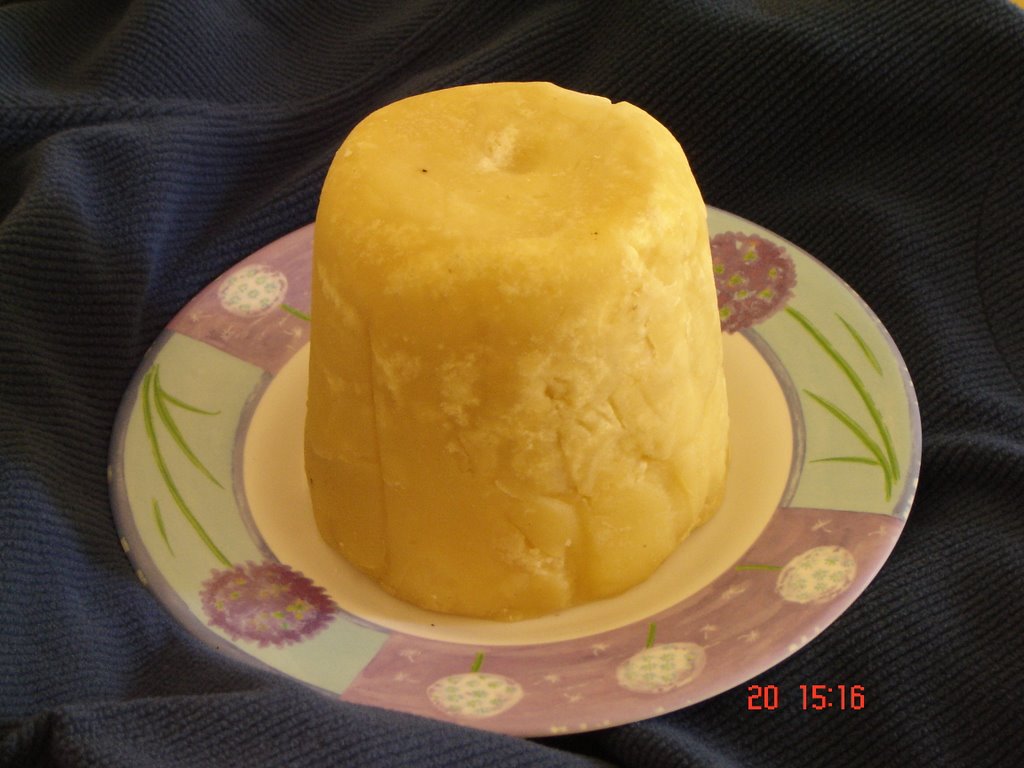
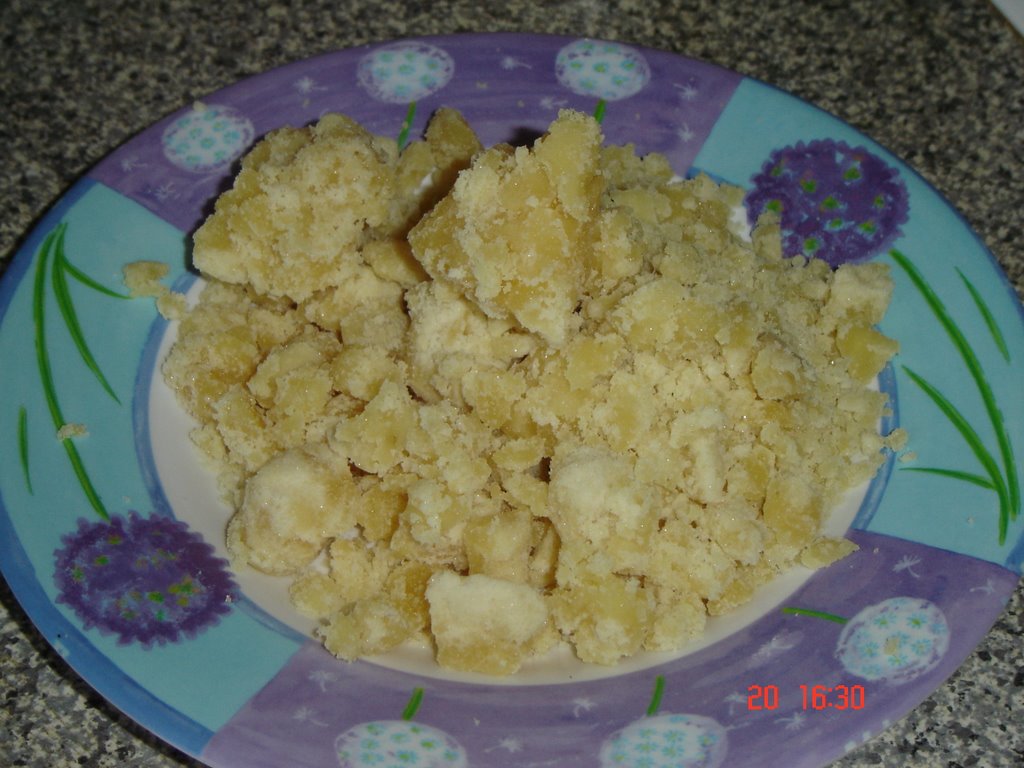
Do you buy jaggery (unrefined palm sugar) in the form of a block and find it tiresome to break it down into smaller pieces. Well just pop the entire block into your microwave and set the microwave on the medium setting for 20 secs (when doing it for the first time keep a close watch on the block because every microwave will operate differently) When you remeve the block it will still look like it did before you put it in. But if you gently press it down with your palm it will easily crumble into a heap. If it doesn't crumble easily just pop it back into the microwave for another 10 to 12 secs. Just take care that the jaggery doesn't start to melt. Try it ! It always works